
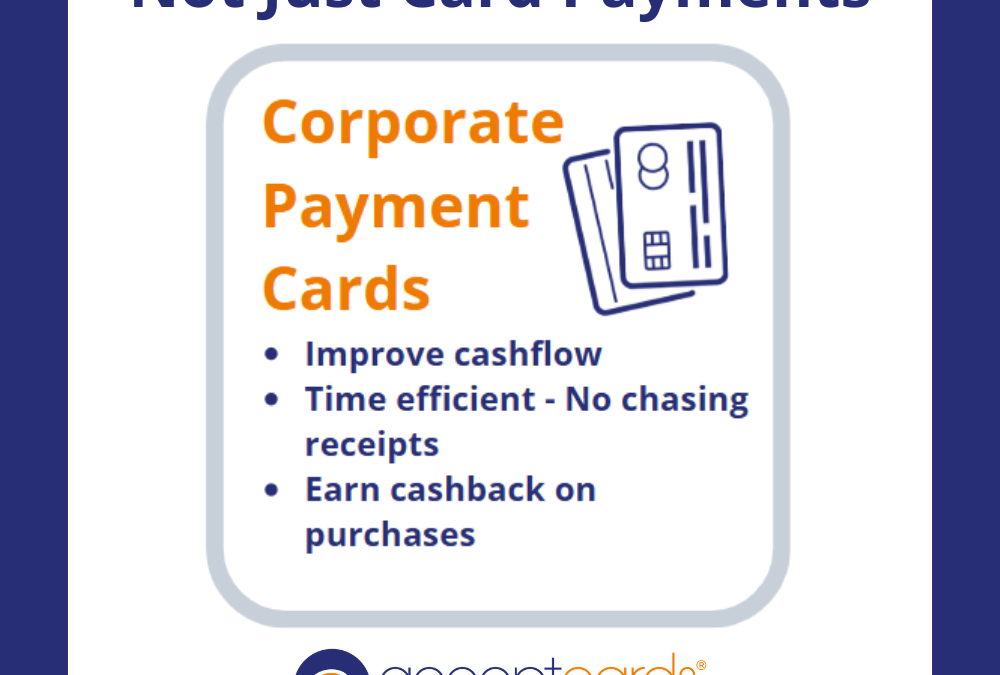
How much time does your business spend managing staff expenses, chasing receipts and working out where its money is going?
For many businesses, managing expenditure becomes more complicated as the team grows. Employees need to make purchases, managers need to keep spending under control, and finance teams need accurate information to keep everything running smoothly.
Corporate payment cards can help bring these processes together.
Continuing our Not Just Card Payments educational series, we’ve already explored Direct Debit and Open Banking. Now we’re looking at corporate payment cards, sometimes called business expense cards or staff spending cards, and how they can help businesses manage their money more effectively.
Because a corporate payment card isn’t simply another way to pay. Used effectively, it can become an important part of a wider strategy for managing business expenditure.
What Are Corporate Payment Cards?
Corporate payment cards allow businesses to provide employees with a way to pay for approved business expenses without relying entirely on personal funds, cash or traditional expense reimbursement processes. Depending on the provider and card arrangement, businesses may be able to issue cards to individual employees, set spending limits, monitor transactions and access reporting tools to help manage expenditure.
They can be used for a variety of business expenses, including:
- Travel and accommodation: flights, hotels and other approved travel costs.
- Staff expenses: meals, mileage-related purchases and other eligible work expenses.
- Business supplies: equipment, materials and everyday operational purchases.
- Subscriptions and software: recurring payments for business tools and services.
- Team and project expenditure: purchases allocated to specific teams, departments or projects.
The precise features available will depend on the card provider and the type of product selected.
The Benefits of Corporate Payment Cards for Businesses
The real value of corporate payment cards goes beyond making purchases. With the right setup, they can help businesses improve control, visibility and efficiency across their spending.
1. Improve control over business expenditure
Giving employees access to a payment card doesn’t have to mean giving up control over how money is spent. Depending on the provider, businesses may be able to establish individual spending limits, apply restrictions and monitor transactions through a central platform. This can help finance teams introduce clearer spending policies while allowing employees to make authorised purchases when they need to.
2. Gain greater visibility over spending
Understanding where money is going is essential for effective financial management. Corporate payment cards can provide transaction information that helps finance teams see expenditure as it happens or shortly afterwards, depending on the provider. Rather than waiting for expense claims to be submitted and processed, businesses may be able to review spending more regularly and identify transactions that need attention.
Better visibility can support more informed decisions about budgets, purchasing and operational costs.
3. Reduce expense administration
Chasing receipts, processing expense claims and reconciling transactions can consume valuable time. Corporate card platforms may help simplify this process through transaction reporting, receipt capture, accounting integrations and automated expense workflows. The exact benefits depend on the tools available and how the business uses them, but the objective is straightforward: reduce unnecessary administration and allow finance teams to focus on more valuable work.
4. Support cash flow management
Corporate payment cards can form part of a wider approach to managing business cash flow. By making expenditure easier to track, businesses can gain a clearer view of spending commitments and how purchases affect available funds. However, card arrangements differ. Some require funds to be available upfront, while others operate on a credit basis. Understanding billing dates, repayment terms, limits and fees is important when assessing how a particular card fits your cash flow requirements.
5. Explore potential cashback and rewards
Some corporate payment cards offer cashback or other rewards on eligible purchases. For businesses with significant expenditure, these benefits may be worth exploring. However, rewards vary by provider and product, and eligibility conditions, fees and spending requirements can apply. The priority should always be choosing an arrangement that supports the business’s needs and represents good overall value, rather than selecting a card based on cashback alone.
Corporate Payment Cards vs Traditional Expense Management
Many businesses still rely on employees paying for expenses themselves and reclaiming the money later, or on finance teams managing purchases through a combination of invoices, bank transfers and manual records.
Corporate payment cards can provide an alternative by allowing approved expenditure to be made through a more structured process.
| Traditional expense management | Corporate payment cards |
|---|---|
| Employees may need to use personal funds | Employees can use an authorised business card |
| Expenses may be submitted after purchases | Transactions may be visible through a central platform |
| Receipts and claims can require manual processing | Digital tools may help simplify receipt capture and reconciliation |
| Spending information may be spread across multiple records | Reporting may bring transactions together in one place |
The benefits depend on the systems already in place and the features offered by the card provider. Corporate cards also require clear policies, appropriate controls and regular monitoring. For many businesses, the best solution is one that combines suitable payment methods with processes that make spending easier to manage.
How to Choose the Right Corporate Payment Card
Before introducing corporate payment cards or reviewing an existing arrangement, it’s worth asking a few practical questions.
What level of control do you need? Consider spending limits, transaction restrictions, approval processes and the ability to manage cards centrally.
How important is real-time visibility? Look at the reporting tools available and whether managers can access the information they need to monitor expenditure effectively.
Will it integrate with your existing systems? Check whether the card platform works with your accounting software, bookkeeping processes and expense management tools.
How does it affect cash flow? Understand whether the card is prepaid, debit-based or credit-based, along with any repayment terms, fees and funding requirements.
What is the overall cost? Review account fees, transaction charges, foreign currency fees, interest where applicable and any conditions attached to rewards or cashback. Taking time to assess these factors can help ensure your corporate payment card arrangement works for your business rather than creating another process to manage.
Corporate Payment Cards: Part of a Bigger Payment Strategy
At acceptcards®, we believe businesses should look beyond individual transactions and consider how their payment arrangements work together. Corporate payment cards are one example of how the right payment solution can support wider business objectives, from improving spending control to simplifying administration and providing better financial visibility.
As businesses grow, these considerations become increasingly important. What works for a small team may not be suitable for a larger organisation with multiple departments, locations or spending requirements. The question isn’t simply, “What card should we use?” It’s “How can we make business spending simpler, more controlled and more efficient?” That’s a much more valuable question to ask.
How Acceptcards Can Help
Our Not Just Card Payments series explores the wider range of payment solutions available to businesses, helping decision-makers understand their options and identify opportunities to improve the way money moves through their organisation. From Direct Debit and Open Banking to corporate payment cards, foreign exchange, cash management and finance solutions, our independent payment consultants can help you explore the options relevant to your business.
You don’t need to become the payment expert. That’s our job.
Ready to Review Your Business Payment Arrangements?
Whether you’re considering corporate payment cards for the first time or already use them and want to understand your options better, the acceptcards® team is here to help. Get in touch to start a conversation about your payment arrangements, business spending and the opportunities available to make your processes work more effectively.
