
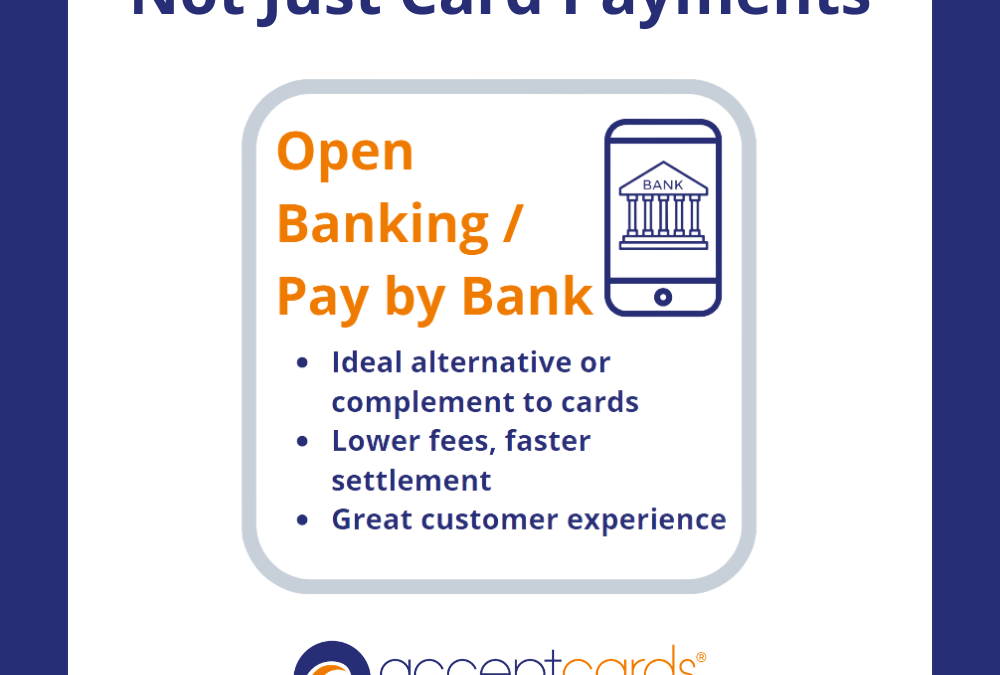
Could your business be giving customers another way to pay while potentially reducing payment costs?
In our previous blog, we explored Direct Debit payments and why the right payment method isn’t always the one a business has traditionally used. Now, as part of our Looking Beyond Card Payments educational series, we’re turning our attention to Open Banking and Pay by Bank.
It’s an increasingly relevant part of the payments landscape, but what does it actually mean for businesses? And how does it fit alongside the card payments you already accept? As with Direct Debit, the aim isn’t to suggest that one payment method should replace another. It’s about understanding the options available and knowing where each one makes sense.
What Is Open Banking?
Open Banking enables customers and businesses to securely share certain financial information or initiate payments through authorised providers, with the appropriate consent.
For payments, one of the most relevant applications is Pay by Bank. Rather than paying with a debit or credit card, a customer can choose to pay directly from their bank account using a supported payment service.
Depending on the provider and payment journey, the customer is typically directed to their banking app or online banking service to authorise the payment. This creates another way for businesses to receive money, alongside traditional card payments and other payment methods.
What Is Pay by Bank and How Does It Work?
Pay by Bank uses Open Banking-enabled payment services to allow a customer to make a payment directly from their bank account.
Although the exact process varies between providers, a typical payment journey works as follows:
- The customer chooses Pay by Bank. At checkout or when making a payment, they select the option to pay directly from their bank account.
- They select their bank. The payment service directs them to the relevant banking environment.
- They authorise the payment. The customer authenticates and approves the transaction through their bank.
- The payment is processed. The payment provider facilitates the transfer and confirms it according to its service and the relevant banking arrangements.
The result is an alternative payment route that can work particularly well for certain online purchases, invoices and business-to-business transactions.
What Are the Potential Benefits of Pay by Bank for Businesses?
The benefits will depend on the provider, transaction type, customer experience and commercial arrangements. However, there are several reasons businesses are exploring Pay by Bank.
1. The potential to reduce payment costs
Card processing fees can represent a high cost for some businesses, particularly where transaction volumes or average payment values are high.
Pay by Bank may provide a more cost-effective option for eligible transactions, depending on the provider’s pricing and the business’s existing arrangements.
The important step is to compare the total cost of each payment method rather than assuming one will always be cheaper.
2. Potentially faster access to funds
Some Pay by Bank services use payment rails that can support near-instant or rapid transfers.
This can help businesses improve the speed at which payments are received in suitable circumstances. However, settlement times and access to funds depend on the payment service, the transaction and the banking arrangements involved.
3. An alternative customer payment experience
Giving customers more choice can help businesses accommodate different preferences. Some customers may prefer to pay by card, while others may welcome the option to pay directly from their bank account without entering card details.
Offering the right mix of payment methods can help create a more flexible payment experience.
4. Greater flexibility across payment channels
Pay by Bank may be useful for online checkouts, payment links and certain invoice collection journeys, depending on the provider’s capabilities.
For businesses taking payments across multiple channels, it can be another option to consider when reviewing how customers pay and how the business receives its money.
Open Banking vs Card Payments: Do You Need to Choose?
This is where the conversation becomes particularly interesting.
Pay by Bank doesn’t have to be a choice between cards and Open Banking.
Card payments remain an important part of the payments landscape. They offer familiarity and convenience across online shopping, face-to-face transactions and many other customer journeys. Open Banking-enabled payments can complement those arrangements by providing an alternative for suitable transactions.
For example, a business might continue accepting cards at its physical premises while offering Pay by Bank as an additional option for online purchases or selected invoice payments. The best approach depends on the business, its customers, transaction values, payment costs and the systems it uses. The opportunity is not necessarily to replace an existing payment method. It’s to understand where alternatives could add value.
Is Pay by Bank Right for Your Business?
Before introducing a new payment method, it’s worth considering a few practical questions:
- What are your current payment costs? Understand what you’re paying across different transaction types.
- How do your customers prefer to pay? Consider where an alternative payment option could be useful.
- When do you need access to funds? Compare the payment and settlement arrangements available.
- How will it integrate with your systems? Check compatibility with your website, payment gateway, accounting software and reconciliation processes.
- What will the overall experience look like? Consider the customer journey, support arrangements and how payment confirmations are handled.
These questions can help establish whether Pay by Bank is worth exploring and where it could complement your existing payment setup.
How Acceptcards Can Help You Look Beyond Card Payments
At acceptcards®, we’re known for helping businesses understand and manage their card payment costs. But our expertise extends beyond traditional card payments. Through our Looking Beyond Card Payments series, we’re helping businesses explore the wider options available, from Direct Debit and Open Banking to foreign exchange, corporate payment cards, cash management and more.
Our independent payment consultants can help you understand the options, assess what may be relevant to your business and make more informed decisions about your payment arrangements. You don’t need to become the payment expert.
That’s our job.
Want to Understand Whether Pay by Bank Could Work for Your Business?
If you’re curious about Open Banking, want to understand Pay by Bank or simply want to review your wider payment costs, we’d be happy to help. Contact us, and we’ll take you through the options step by step, giving you a clearer understanding without the hassle.
Because better payment decisions start with understanding what’s available.
